Introduction
Mention math to a kindergartener (LKG or UKG), and they might picture columns of abstract numbers like 3 + 2 = 5. For a four- or five-year-old child, these symbols look like a foreign language. Without a physical or visual anchor, memorizing equations is exhausting and quickly leads to math anxiety.
Early childhood educators know that children learn best through concrete contexts. The most powerful way to introduce basic addition, subtraction, and counting is through Story-Based Math (or Math Stories). By wrapping mathematical concepts in an engaging story, children use their natural language and imagination skills to solve problems.
Why Math Stories Work for Kindergarteners
Story-Based Math bridges the gap between abstract symbols and real-world counting. Here is why storytelling is a game-changer for early math:
- Creates a Visual Context: When you say "Two birds sat on a branch, and one more flew in," a child visualizes the birds. They don't need to memorize a formula; they just count the birds in their mind.
- Answers the "Why": Math stories show children why math is useful. It isn't just a school drill; it is how we share cookies, count toys, or track points in a game.
- Reduces Math Anxiety: Stories feel like play. When math is presented as a storytelling adventure, children drop their guards and participate eagerly.
3 Simple Math Story Templates for Parents
You can tell these quick math stories at home using real toys or everyday objects to make them tactile:
1. The Picnic Sharing Story (Addition & Division Prep)
- Concept: Adding groups together.
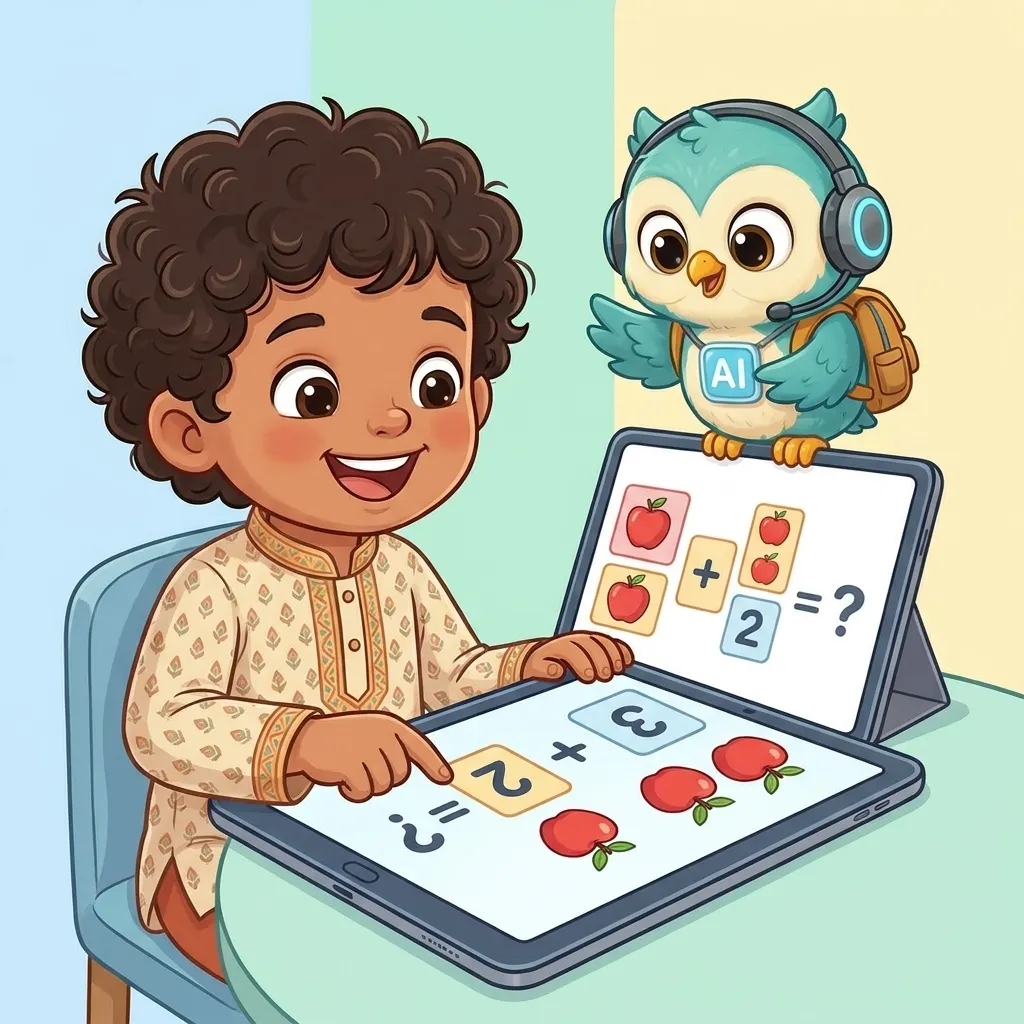
- Story: "Owlie went on a picnic. He brought 3 sweet apples in his backpack. His friend brought 2 juicy pears. When they sat down, how many fruits did they have altogether?"
- Tactile Tip: Lay out 3 toy blocks (apples) and 2 buttons (pears). Let your child slide them into one pile and count them: "1, 2, 3, 4, 5!"
2. The Squirrel's Acorns (Subtraction)
- Concept: Taking away from a group.
- Story: "A busy little squirrel collected 5 brown acorns and lined them up on a log. While he was sleeping, a friendly crow flew down and took 2 acorns. How many acorns did the squirrel have when he woke up?"
- Tactile Tip: Place 5 coins on a table. Let your child pretend to be the crow, take 2 away, and count the remaining 3.
3. The Toy Car Garage (Counting & Comparison)
- Concept: Counting, adding, and comparing numbers.
- Story: "The red garage has 4 toy cars parked inside. The blue garage has 2 cars. Which garage has more cars? How many cars do we have in total?"
- Tactile Tip: Use toy cars or building blocks to represent the garages, helping your child compare heights or counts physically.
Interactive Math Stories inside PLG Kids
To support parents who want structured early math practice, the PLG Kids app features a dedicated Math Stories module.
   [ Screen Shows Story ]  👉  [ Child Interacts ]  👉  [ Speech Verification ]
("Owlie finds 3 stars...")     (Drags stars to backpack)    (Speaks: "Now he has 4!")
Our app merges storytelling with interactive gameplay:
- Guided Visual Stories: Children follow characters like Owlie through beautiful landscapes as they collect stars, share snacks, or build toy towers.
- Interactive Drag-and-Drop: Kids physically drag items (like apples or toys) on screen to solve problems, reinforcing the mathematical concept with physical actions.
- Speech-Based Answers: Instead of multiple-choice buttons, the app prompts kids to speak the final answer aloud: "How many toys does Owlie have now?". Our local speech check verifies the oral response to ensure active thinking.
Check out the interactive activities in the PLG Kids learning app today!
Frequently Asked Questions (FAQ)
What math concepts should an LKG/UKG child know?
LKG children focus on counting 1 to 20, matching shapes, recognizing patterns, and identifying "more vs. less". UKG children progress to counting up to 50, basic single-digit addition and subtraction (up to 10), and solving simple oral word problems.
How do I help a child who struggles to count past 10?
This is very common. The teen numbers (11 to 19) don't follow the clear naming pattern of later numbers (twenty-one, twenty-two, etc.). Practice with tactile objects: make a pile of 10 items, and add 1 more to show "10 and 1 is 11", "10 and 2 is 12", building a physical understanding of double digits.
Should I use worksheets for kindergarten math?
At age 4 or 5, keep paper worksheets to a minimum. Focus instead on conversational stories, tactile games with toys/coins, and interactive apps that turn math into an active physical and verbal game.