Introduction
Participating in a school Spelling Bee is a fantastic way for children in UKG, Class 1, and Class 2 to build vocabulary, pronunciation clarity, and public-speaking confidence. However, preparing for a spelling bee can quickly become stressful if it is treated as a boring memorization drill.
Forcing a child to write list after list of words (rote learning) rarely works. Instead, the secret to Spelling Bee success is phonetic decoding and gamified practice. By helping children understand the blocks of sounds that build a word, they learn to spell logically, allowing them to decode unfamiliar words during a competition.
The Core Concept: Sound Blocks Over Memorization
When children try to memorize letters individually (e.g., spelling f-a-n-t-a-s-t-i-c letter-by-letter), their working memory gets overwhelmed. Instead, spelling champions use two main techniques:
- Phonetic Chunking: Breaking words into their constituent phonemes (sounds).
- Syllabication: Dividing long words into smaller beats or syllables (e.g., fan-tas-tic has 3 beats).
Teaching these skills through physical and digital games keeps prep work light, fun, and highly effective.
4 Gamified Spelling Bee Drills for Parents
Here are four simple spelling games you can practice at home with paper cards or toys:
1. The Syllable Clap
- Goal: Help kids break long words into manageable beats.
- Steps:
- Call out a word: "Butterfly!"
- Clap together for each beat: "But- (clap) -ter- (clap) -fly (clap)!"
- Count the claps (3 claps).
- Now, spell each syllable individually: B-U-T -> T-E-R -> F-L-Y. This makes spelling long words look like simple 3-letter puzzles.
2. Missing Letter Board
- Goal: Train visual recognition of spelling patterns.
- Steps:
- Write a word on a whiteboard, leaving blank spaces for the vowels (e.g., F _ S H or B _ L L).
- Provide magnetic letters or markers and let your child fill in the blank.
- Vary the missing letters to focus on digraphs (e.g., _ _ I P for ship).
3. Word Family Piles
- Goal: Teach rhyming word patterns.
- Steps:
- Write several word endings on index cards (e.g., -at, -in, -og).
- Write single consonants on separate cards.
- Let your child match consonants to the endings to build piles of words: cat, bat, mat or pin, tin, bin. This reinforces that spelling changes systematically.
4. Sound Builder Puzzles (Drag-and-Drop)
- Goal: Translate oral sounds into spelled letters.
- Steps:
- Pronounce a word slowly: "/b/--/e/--/d/".
- Ask your child to pick the letters that make each sound and place them in order to "build" the word bed.
How PLG Kids Prepares Children for Spelling Bees
At LittleLearn AI, we designed a complete Spelling Bee Competition Prep module for early primary students.
   [ Hear Word Aloud ]  👉  [ Syllable Split Game ]  👉  [ Speech Verification ]
("Spell: Elephant")          (Chunks: El-e-phant)         (Child speaks letters aloud)
Our spelling module includes four interactive engines:
- Syllable Split: Kids tap screen assets to chop long words into distinct, clap-friendly sound chunks.
- Sound Builder: A gamified letter-puzzle interface where kids drag phoneme blocks to spell spoken words.
- Prefix & Suffix Puzzles: Teaches kids how word endings (like -ing, -ed, -est) change root words.
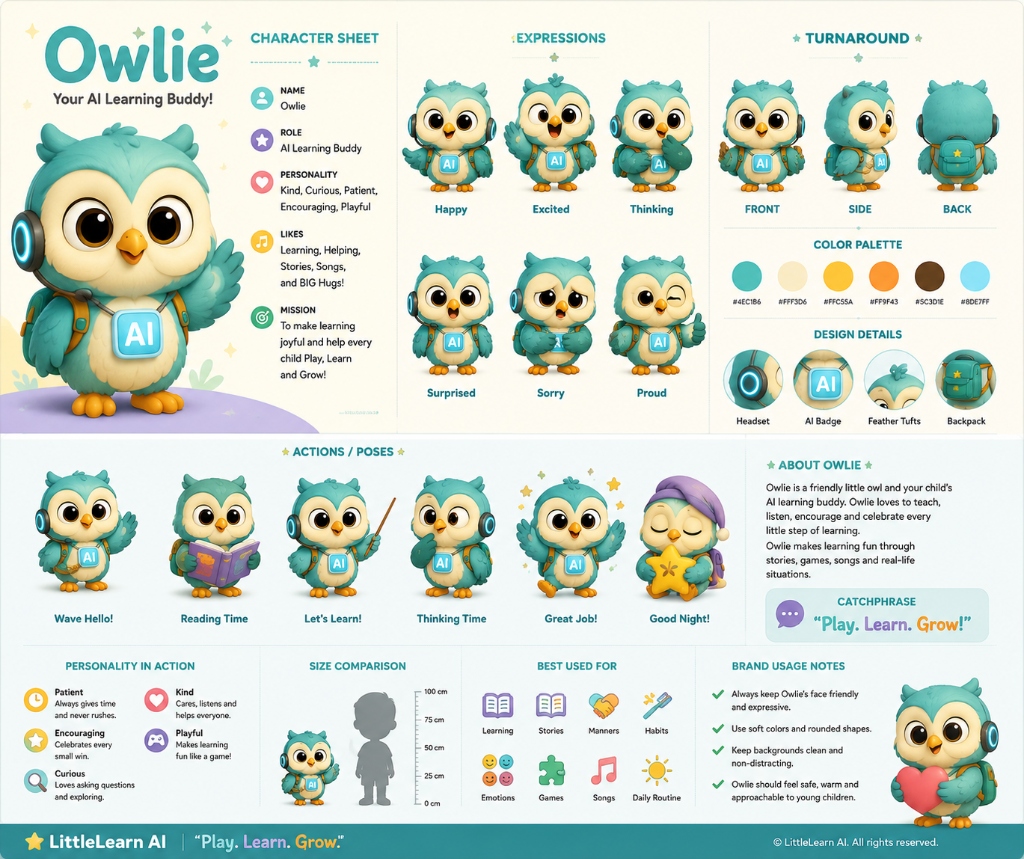
- Microphone Spelling Checks: Mimicking the actual spelling bee format, the app prompts kids to listen to a word, speak the individual letters into the microphone, and receive instant, encouraging evaluation from Owlie.
Check out the interactive activities in the PLG Kids learning app today!
Frequently Asked Questions (FAQ)
At what age can a child start spelling bee practice?
You can start introducing simple syllable-clapping games and CVC word building around age 4 (LKG/UKG). Structured spelling bee games with longer words are ideal for children aged 5 to 7 (Class 1 & 2).
What if my child spells a word incorrectly in the app?
Our AI learning buddy, Owlie, is designed to be highly encouraging. Instead of a harsh buzz or penalty, Owlie displays a thinking expression and models the phonics sounds again: "Let's listen to the sounds: /sh/--/i/--/p/... try spelling it again!"
How many words should a Class 1 student know for a spelling bee?
For Class 1 competitions, children are typically expected to spell 100-150 common words, including 3-letter CVC words, basic digraphs (fish, chin, bath), and early primary sight words.